Destin’s beaches are genuinely exceptional — calm Gulf water, sugar-white sand, and warm temperatures from May through October. By the standards of Gulf Coast swimming, this is one of the more forgiving beach environments in the Southeast. But “more forgiving” isn’t “without risk,” and a handful of hazards catch visitors off guard every summer: rip currents on flag days, jellyfish during bloom season, stingrays in the shallows, and Florida sun that’s significantly more intense than most inland climates. Most beach-related incidents here are preventable with basic knowledge.
This guide covers everything worth knowing before your first beach day: the flag system, rip currents, marine life, sun and heat safety, child-specific precautions, and the emergency resources available when something goes wrong. Millions of people swim at Destin beaches every year without incident. This is how you stay in that majority.

The Destin Beach Flag System: What Every Color Means
Okaloosa County flies beach safety flags at public access points throughout Destin, Miramar Beach, and Fort Walton Beach. The flags are updated daily — sometimes more than once — based on surf conditions, wind speed, rip current activity, and marine life reports. Checking the flag before you get in the water is the single most effective beach safety habit you can develop. Locals do it automatically every time they arrive at the beach.
Green Flag — Low Hazard
Calm conditions, low surf, minimal rip current risk. This is your best swimming day. Green flag mornings in May, September, and October are some of the most pleasant beach experiences the Emerald Coast offers — glassy water, easy entry, and visibility straight to the sandy bottom. In summer, green flags are most common in early morning before afternoon sea breezes build.
Yellow Flag — Medium Hazard
Moderate surf or currents. Most competent adult swimmers handle yellow flag conditions without difficulty, but children and weak swimmers should stay in waist-deep water or shallower. Some rip current risk exists, and the shore break carries enough force to knock small children off their feet. If you’re unsure about your swimming ability, watch how the water moves from shore before going deeper than waist level.
Red Flag — High Hazard
Dangerous surf and/or strong rip currents. The majority of serious beach incidents in Destin happen on red flag days when visitors misjudge conditions. Strong swimmers are not immune to rip currents — the current can exhaust even experienced swimmers if they fight it the wrong way. The practical rule: children and non-swimmers stay out of the Gulf entirely on red flag days. Adults who choose to enter should stay in water below the knee and watch conditions carefully. This is not a moment for overconfidence.
Double Red Flag — Water Closed
Swimming is prohibited. Double red flags mean conditions are genuinely dangerous — typically tropical system surf, extreme rip currents, or both. Entering the Gulf on a double red day is illegal in Okaloosa County and carries a fine. The honest version: double red days have killed experienced swimmers in Destin. The beach itself remains beautiful and safe to walk; watching dramatic surf from shore is perfectly reasonable. But the water is off-limits.
Purple Flag — Dangerous Marine Life
A purple flag is flown alongside another color flag (not independently) to indicate that dangerous marine life has been observed in the area — most often jellyfish blooms or, occasionally, Portuguese man-of-war blown in by offshore winds. A purple flag on an otherwise calm green flag day still calls for caution: wear water shoes when wading, scan the water surface before entering, and skip extended swimming if jellyfish are visible in the wave wash. See our dedicated beach flag system guide for the full breakdown of conditions and flag history by season.

Rip Currents: How to Spot Them, Avoid Them, and Escape If Caught
Rip currents are the primary life-safety hazard on Destin’s beaches. They’re responsible for the vast majority of lifeguard rescues along the Gulf Coast, and they’re the reason the flag system exists. Understanding rip currents — what they are, how to recognize them, and what to do if caught in one — is the most important safety knowledge for any beach swimmer, regardless of experience level.
What a Rip Current Actually Is
A rip current is a narrow, fast-moving channel of water flowing outward from shore through the surf zone. It forms when waves push water toward the beach faster than it can spread laterally along the shore; the water finds the path of least resistance — usually a break in a sandbar — and surges back out to sea in a concentrated corridor. The current runs perpendicular to the shoreline, out through the wave break zone. Rip currents can move at 1 to 8 feet per second — faster than most competitive swimmers can sprint through water.
How to Spot a Rip Current from Shore
Before entering the water, look for these visual indicators:
- A channel of darker, choppier water cutting through the breaking waves
- A gap where waves aren’t breaking — a calmer-looking corridor between surf on either side
- Foam, sea foam, or floating debris moving consistently seaward through a narrow band
- A discolored plume of churned-up sand extending past the break zone into clearer water
Rip currents are easiest to spot from an elevated vantage point — a beach access walkover or the top of a dune — rather than from water level. A minute of scanning from above before you go in is one of the best habits you can develop. Local lifeguards watch specific spots on the beach where rip currents form regularly; if you see a lifeguard watching one area intently, there’s usually a reason.
If You’re Caught in One
The instinct is to swim hard toward shore. That puts you directly against the current and will exhaust you without making progress. The correct response:
- Don’t panic. A rip current pulls you away from shore, not underwater. It will dissipate once you’re past the surf break.
- Swim parallel to shore — across the current rather than against it. Most rip current channels are only 20 to 100 feet wide. Once you feel the pull weaken, you’re free of it.
- From outside the current, swim back to shore at an angle to avoid re-entering the channel.
- If you’re too tired to swim back, float, stay calm, and signal for help by waving one arm above your head. Lifeguards and beach patrol are trained to respond to this exactly. Don’t fight both the current and exhaustion at the same time.
Our full rip currents in Destin guide covers seasonal patterns, which beach access points have the highest rip current frequency, and how to read current conditions in the NOAA surf forecast before you arrive.

Marine Life Safety: Jellyfish, Stingrays & Sharks
The Gulf of Mexico has abundant marine life, and the vast majority of it presents no threat to swimmers. Three species are worth understanding before you get in the water: jellyfish (common), stingrays (seasonally present in the shallows), and sharks (present but rarely a problem with reasonable precautions).
Jellyfish
Jellyfish are the most frequent marine life encounter in Destin. Moon jellyfish — translucent domes with four visible pink circles, typically 4 to 10 inches across — are the most common species. Their sting is mild, producing a brief burning or itching sensation that most adults compare to a light sunburn. Cannonball jellyfish appear in large aggregations during fall months and are essentially harmless; their sting is barely perceptible.
The one that warrants real caution: Portuguese man-of-war, which occasionally blow in on strong offshore winds (most common in spring and after storm systems). They look unlike anything else in the water — a translucent blue or purple sail floating above the surface, with long trailing tentacles below. Their sting is extremely painful and can cause systemic reactions requiring medical attention. If you see a purple-sailed floating organism washed up on the beach or floating in the water, stay well clear and alert lifeguards. A purple beach flag is typically flown when man-of-war are present.
Jellyfish sting treatment: Rinse with seawater (not fresh water, which can trigger unfired nematocysts). Remove visible tentacle material by scraping with a card edge or shell — not rubbing. Commercial jellyfish sting relief spray (available at beach shops and lifeguard stations) works significantly better than the folk remedies. If a child or anyone with a history of allergies develops anything beyond local skin irritation — difficulty breathing, throat tightening, widespread hives, fainting — call 911 immediately. Read our Destin jellyfish guide for more on species, seasonality, and treatment.
Stingrays
Southern stingrays rest buried in the sandy Gulf bottom in the shallow water where people wade — exactly where families spend most of their beach time. Stingrays aren’t aggressive; stings happen when a swimmer steps directly onto a buried ray. The injury can be significant, but it is almost entirely preventable with one habit: the stingray shuffle. Slide your feet along the sandy bottom as you walk rather than lifting and stepping. The vibration sends any ray nearby scooting away before your foot comes down. Teach this to every person in your group before they enter the water. It genuinely works.
Stingray sting treatment: The barb can break off in the wound. Do not attempt to remove a deeply embedded barb yourself — go directly to urgent care or the ER. For a clean wound, immerse the affected area in the hottest water you can tolerate for 30 to 90 minutes; heat denatures the venom protein and significantly reduces pain. Lifeguard stations carry hot water and can assist with first-response care. Most stingray wounds heal well when treated promptly and don’t result in lasting complications.
Sharks
Sharks live in the Gulf of Mexico. Spinner sharks and blacktip sharks come relatively close to shore seasonally, particularly during spring and summer mullet runs. Destin shark bites are rare; fatal attacks along this stretch of the Gulf Coast are extremely rare. Risk reduction is straightforward: avoid swimming at dawn and dusk when sharks feed most actively near shore; skip the shiny jewelry (it can look like fish scales to a shark); don’t swim near people fishing from piers or the beach (bait and catch both attract sharks); and avoid the water with open wounds. Our Destin shark guide provides species-by-species context, seasonal risk windows, and what actually warrants concern versus what doesn’t.

Sun Protection & Heat Safety on Florida’s Gulf Coast
Sunburn and heat illness ruin more Destin vacations than rip currents, jellyfish, and stingrays combined. This isn’t a minor point: Florida’s Gulf Coast in summer has a UV index of 10 to 11+ (extreme) between 10am and 3pm. Visitors from climates where summer UV peaks at 6 or 7 routinely underestimate how fast they burn here. The white quartz sand compounds the problem by reflecting UV back upward from below, increasing your exposure even under a beach umbrella. A morning of beach time with inadequate protection can produce a burn painful enough to sideline the rest of the trip.
Sunscreen Basics
SPF 50 broad-spectrum sunscreen applied 20 to 30 minutes before beach time, reapplied every 90 minutes, and reapplied immediately after swimming. That’s not the aggressive option — it’s the baseline for this environment. Apply more than you think you need; most people use about a third of the recommended amount. Water-resistant formulas hold up better in the surf zone than spray-on versions. Don’t neglect ears, the back of the neck, tops of feet, and tops of shoulders — these spots are the most commonly missed and hurt the most afterward.
Clothing and Physical Sun Barriers
A wide-brim hat (4-inch brim or larger) blocks UV from reaching the face, ears, and neck — the areas where cumulative sun damage adds up fastest. UPF 50 sun shirts (rash guards) are worth packing: they provide full-coverage protection that doesn’t wash off and doesn’t need reapplication, making them particularly practical for kids who will be in and out of the water all day. Beach umbrellas help but don’t eliminate UV exposure due to reflected sand light; sunscreen is still needed under the umbrella.
Heat and Hydration
On a typical August day in Destin, air temperature reaches 90 to 95°F with high humidity and a heat index that can top 105°F in the sun. Heat exhaustion (heavy sweating, weakness, pale or clammy skin, nausea, fast weak pulse) is a signal to move into air conditioning and consume water or electrolytes immediately. Heat stroke (hot and dry skin, confusion, rapid heartbeat, possible unconsciousness) is a medical emergency requiring 911. The simplest prevention: drink water consistently before you feel thirsty, schedule mandatory shade breaks through the worst heat, and pay real attention to how every person in your group is doing. Young children and elderly adults are the most vulnerable.
Timing Your Beach Day
The local approach: beach from 7:30 to 10:30am (cooler, golden light, thinner crowds, manageable UV), off the beach through midday, then return for 4:00 to 6:30pm (golden-hour light, temperature drop, beach thins out dramatically). This schedule gives you better quality beach time, less sun damage, and more energy for the rest of the day than sitting in direct sun from 10am to 4pm. The midday gap is when you explore restaurants, take a nap, or enjoy the pool at your rental.

Keeping Kids Safe at Destin Beaches
Destin is a genuinely family-friendly beach environment — the Gulf is calmer here than Atlantic beaches, the water is warm from May through October, and the gradual bottom slope creates a long, shallow wading zone ideal for young children. The precautions needed are the standard precautions for any beach, applied consistently and without distraction.
Active Supervision
The standard recommendation for children who can’t swim independently is touch supervision — a parent within arm’s reach of the child at all times when they’re in or near the water. This means watching, not passively nearby. Lifeguards cover a wide stretch of beach with many swimmers simultaneously; they are not substitutes for direct parental attention. A child who gets knocked down by a wave in 18 inches of water can drown in seconds if no one is watching. This is the same at Destin as at any beach.
Floatation Devices
Only Coast Guard-approved life jackets (Type II or III, sized by child weight) are appropriate floatation devices in open Gulf water. Pool floaties, arm wings, and inflatable rings are not Coast Guard-approved and are not designed for unpredictable surf — they create a false sense of security that can be deadly. If your child cannot swim independently and will be in water above waist depth, a properly fitted life jacket is the right call. Several beach rental shops in Destin carry children’s PFDs for daily rental.
Identification for Young Children
On a crowded summer beach, temporary separation of young children happens. Write a phone number on your young child’s arm or inner wrist with a Sharpie at the start of each beach day, or use a waterproof wristband with contact information. This is how lifeguards and beach patrol identify and contact parents when a child gets separated. It takes 15 seconds and matters on the one day something unexpected happens.
Shore Break and Wave Safety
Even on yellow flag days with moderate surf, shore break waves carry enough force to knock a 30- to 40-pound child completely off their feet. A wave an adult barely notices can tumble a toddler. Keep very young children in the wave-wash zone (where spent waves roll up and back along the sand) and in ankle-to-knee depth at most until you’ve assessed conditions. The wet sand just at the water’s edge is typically the safest playing zone for toddlers and young children.
The Stingray Shuffle for Kids
Teach the stingray shuffle to every child before they enter the water: slide feet along the bottom rather than lifting and placing. Kids often instinctively hop in shallow water, which increases stingray encounter risk. Making the shuffle feel like a game (penguin walk, flat-foot slide) before the first beach day works better than trying to correct mid-water.

Emergency Resources: Lifeguards, Beach Patrol & Medical Care in Destin
Knowing what’s available before you need it is part of preparation. Here’s the realistic picture of beach safety infrastructure in Destin and Miramar Beach:
Lifeguards
Okaloosa County Beach Safety provides lifeguard coverage at major public beach access points from Memorial Day through Labor Day. Coverage is not continuous at every access point, particularly at smaller or more remote access locations and throughout the off-season. Some private resorts and condominiums post their own lifeguards during summer. Knowing whether your specific beach has lifeguard coverage is worthwhile, but a beach without a lifeguard isn’t unsafe — it simply means your own situational awareness carries more weight.
Okaloosa County Beach Safety Patrol
Beach Safety patrol units drive the waterline throughout daylight hours and carry emergency response equipment including rescue boards and medical supplies. They coordinate directly with Okaloosa County EMS. In any water emergency, call 911 immediately rather than trying to locate a lifeguard tower. The 911 dispatcher will route the appropriate resources to your exact location. For non-emergency assistance — a minor injury, information about current conditions, or a found child — flag down a patrol unit on the beach or go to a lifeguard station.
Medical Facilities
HCA Florida Fort Walton-Destin Hospital on US-98 in Fort Walton Beach is the full-service emergency hospital for the area, about 10 to 15 minutes from central Destin. For non-emergency situations — jellyfish stings, stingray wounds, minor lacerations, or heat illness that responded to initial self-treatment — several urgent care clinics operate along US-98 in Destin and Miramar Beach and can treat beach-related injuries without the emergency room wait. Find the nearest urgent care address before your trip starts and have it in your phone rather than searching for it when someone is in pain and you need to move immediately.
Practical Beach Day Reminders
- Tell someone not at the beach where you’re going and approximately when you’ll be back
- Keep your phone charged before heading out — batteries deplete faster in heat and direct sun
- Pack a basic first aid kit with antiseptic, bandages, and commercial sting relief spray
- Never leave children or pets in vehicles in beach parking lots — interior car temperatures reach dangerous levels in minutes in Florida summer conditions
- Cell coverage is generally solid throughout Destin and Miramar Beach — 911 works reliably from beach access points
- Bring enough water for the entire group; plan on more than you think you need in summer heat
A Home Base That Makes Safety Easier
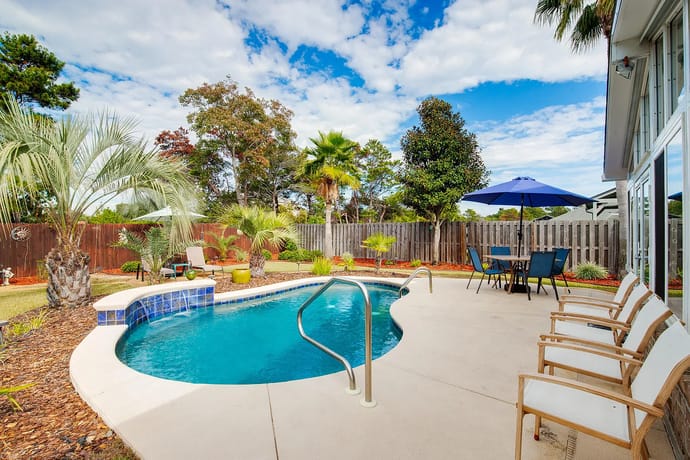
Both of our vacation rentals put you close to the water without being far from everything else. Our Miramar Beach rental has a private pool — on red flag days, or during the midday heat when the Gulf is at its most intense, you have a safe, cool alternative right at the house. 4 bedrooms, sleeps 8, from $225/night.
Our Destin rental is pet-friendly and sleeps 12 across 3 bedrooms plus a bunk room — ideal for larger families who want the space of a home base rather than a hotel, with room to decompress between beach days. From $110/night.