Destin keeps showing up on retirement destination shortlists, and not just because of the beach. The Florida Panhandle offers a combination of climate, cost, community, and outdoor lifestyle that genuinely works — especially for retirees coming from high-tax states or cold-weather cities. But there are real considerations that most “best places to retire” articles skip: healthcare access, traffic, summer heat, and the important difference between loving a place as a vacation destination versus actually living there year-round.
This guide is the honest version — not a real-estate sales pitch. If Destin is the right fit for your retirement, you’ll have a clear picture after reading this. If it isn’t, you’ll know that too.

Why Retirees Keep Landing on Destin
The core appeal isn’t complicated. Florida has no state income tax. The Gulf water along the Panhandle is genuinely emerald green — that color you see in photos is real, year after year. Winters are mild enough for outdoor activity most days. And the pace of life here is slower and more manageable than most of South Florida, without feeling remote.
Destin is also less expensive than comparable beach retirement markets. Compared to Naples, Sarasota, or Delray Beach, housing costs along the Panhandle are meaningfully lower, property taxes are modest, and day-to-day costs like groceries and dining are more reasonable. The tradeoff is isolation: Destin is 50 minutes from the nearest mid-size airport (Pensacola) and about 90 minutes from a true urban center. For retirees who don’t need constant city access, this is barely a consideration. For those who travel frequently or rely on large-city medical specialists, it’s worth factoring in seriously.
Climate in numbers: Average January high is 61°F — jacket weather, not cold. Average July high is 90°F with genuine humidity; most long-term residents structure outdoor activity around early mornings and evenings in summer. Gulf water hits 84–86°F in July–August and stays swimmable (75°F+) from May through October. The Panhandle is in a Gulf hurricane zone — the last major direct hit on the Destin area was 2004. Most residents keep a storm kit and have a plan; it’s not the constant anxiety that parts of South Florida deal with.
- No state income tax — Social Security, pension income, and IRA withdrawals are all state-tax-free in Florida
- Homestead exemption — Florida’s homestead exemption reduces assessed value on a primary residence by up to $50,000, and the Save Our Homes cap limits annual assessment increases to 3% or CPI, whichever is lower
- Year-round outdoor weather — The Panhandle has more golf courses per capita than almost anywhere in the Southeast, and the winter months are ideal for the game
- Strong military & veteran community — Eglin Air Force Base and Hurlburt Field are nearby; VA outpatient clinic in Fort Walton Beach; commissary access
- Familiar regional culture — Many retirees from Alabama, Georgia, Tennessee, and the Florida interior feel immediately at home here; SEC sports culture is strong

Cost of Living: What to Actually Budget
Destin is a beach community — prices reflect that — but it’s substantially more affordable than most comparable coastal Florida markets. Here’s a realistic breakdown for 2026:
Housing
A 3-bedroom, 2-bath single-family home in Destin or Miramar Beach runs $550,000–$850,000 depending on proximity to the Gulf. More modest 2BR/2BA homes (half a mile to a mile from the water) are available in the $350,000–$550,000 range. Condos in the Sandestin, Emerald Isle, and Crystal Beach areas range from $350,000 for a 1BR to $700,000+ for a large 2BR Gulf-front unit. Gated golf communities like Kelly Plantation push into $600K–$1.2M for single-family homes. For context: equivalent properties in Naples typically run $200,000–$400,000 more for similar square footage and water proximity.
Monthly Estimate for a Couple
- Housing (mortgage or rent on a modest 2BR): $1,800–$3,000/month
- Property taxes (on a $550K homesteaded residence): ~$300–$400/month
- Homeowner’s insurance: $250–$550/month — this has risen sharply; get quotes before you buy and factor it seriously into your budget
- Groceries (couple, cooking most meals): $600–$850/month; Publix and Winn-Dixie are close, Costco is 45 minutes away in Pensacola
- Dining out (2–4 times/week for two): $800–$1,400/month at mid-range Destin restaurants
- Utilities (electric, internet, water): $250–$350/month shoulder season, $350–$500/month in summer with A/C running
- Healthcare (Medicare supplement + out-of-pocket): $400–$800/month depending on plan and health needs
- Activities, golf, entertainment: $300–$700/month depending on lifestyle
- Total monthly estimate excluding housing purchase: roughly $5,500–$7,500/month for a couple
The insurance reality: Florida homeowner’s insurance is the single biggest financial surprise for recent movers. Rates have climbed dramatically statewide — particularly for coastal properties within a mile of the water. Wind mitigation credits help (get an inspection), but budget $3,000–$6,000/year for insurance on a typical Destin-area home, and get real quotes before you commit.

Best Areas & Communities for Retirees Near Destin
The Destin/Miramar Beach/30A corridor offers several distinct retirement contexts. Here’s how they differ in daily-life character:
- Sandestin Golf & Beach Resort — The most resort-style option: a gated community spanning 2,400 acres with four golf courses, a marina, beach club, Baytowne Wharf dining village, tennis courts, and internal shuttle service. Attracts a mix of full-time residents, part-timers, and vacation rental owners. HOA fees are real ($500–$900/month depending on property type) but cover a lot. Ideal for retirees who want on-site amenities without a car trip for every activity.
- Miramar Beach — The quieter, more residential stretch west of central Destin. Lower tourist density than the harbor area, convenient to Silver Sands Outlets and the US-98 Publix. Many retirees favor Miramar Beach for daily livability while staying within 10–15 minutes of everything Destin offers. More single-family neighborhoods, less seasonal flux.
- Kelly Plantation / Bluewater Bay (Niceville area) — Gated, golf-focused communities 15–20 minutes east of Destin. Notably quieter, lower density, more oriented toward year-round full-time residents than vacation traffic. Housing costs are lower than Gulf-front Destin and the community is mature and established.
- Fort Walton Beach / Shalimar — 10–15 minutes east of Destin on the bay side. Significantly lower housing costs than Destin proper: solid 3BR homes run $280,000–$450,000. More local-resident focused, strong military community presence. Trade-off: you’re not walking to the beach, but you’re a short drive.
- 30A corridor (Santa Rosa Beach, Grayton Beach, Seaside area) — West of Destin, this is a more arts-and-community-oriented coastal zone. Walkable in places, more architecturally distinctive neighborhoods (Seaside, Watercolor, Rosemary Beach). Home prices are comparable to or higher than Destin in the premium communities. Good fit for retirees who want character and community over amenity-resort feel.
Important note: The daily-life differences between these areas are significant — enough that many buyers end up somewhere different from where they originally planned after spending extended time in the area. This is exactly why the long-stay trial run covered in the last section is so consistently valuable.

Healthcare, Logistics & What to Know Before You Commit
Healthcare is the most critical practical consideration in any retirement move. The Destin area is better served than its size would suggest — but it has real limitations for complex specialty care.
Medical Facilities
- HCA Florida Fort Walton-Destin Hospital (Fort Walton Beach, 15 min) — The primary full-service hospital for the region. 285 beds, 24/7 emergency, surgical services, cardiac care, and most general specialties. This is where most Destin-area residents go for acute care.
- Sacred Heart Hospital on the Emerald Coast (Miramar Beach, 10 min) — A smaller facility with convenient location near Sandestin. Handles most standard cases; complex surgery often routes to Sacred Heart Pensacola (50 min).
- Specialty care reality: The Panhandle lacks some specialty services available in major Florida metros. Complex oncology, advanced cardiac surgery, and specialized neurology commonly route to Pensacola, Gainesville (UF Health), or Tampa. If you have ongoing serious conditions requiring frequent specialist visits, build travel time for those appointments into your planning.
- VA access: VA Community Based Outpatient Clinic in Fort Walton Beach. Full VA services at Bay Pines VA (St. Petersburg) or Pensacola area for scheduled care.
- Medicare Advantage coverage: Humana, UnitedHealthcare, and BCBS of Florida all have solid network coverage in Okaloosa and Walton counties. Verify plan networks carefully before selecting a plan.
Practical Realities
- Car dependence: Destin is not walkable for daily errands. Two-car households are the norm. If you’re planning to downsize to one vehicle in retirement, think through this carefully — groceries, medical appointments, and dining all require driving.
- Summer traffic on US-98: The main highway through Destin gridlocks on summer weekend afternoons. Locals time errands before 11am or after 7pm in July–August. After Labor Day it largely disappears. If you plan to summer here full-time, this is manageable but part of the reality.
- Airport access: Pensacola International (PNS, 50 min) is the primary airport. Northwest Florida Beaches International (VPS, 45 min east) has a growing route network. Neither is a major hub — connections through Atlanta, Dallas, or Charlotte are standard for long-haul flights.
- Internet & connectivity: Fiber gigabit internet from Cox and Mediacom is available throughout most of Destin and Miramar Beach. Cell service from all major carriers is solid on main corridors; some residential areas toward 30A get spottier coverage off the primary roads.

What Retirees Actually Do Here — Activities & Daily Life
The outdoor lifestyle that draws retirees to Destin turns out to be genuinely accessible year-round — not just in the vacation months. Here’s what a typical week actually looks like for long-term residents:
- Kayaking & Paddleboarding — The bay and protected backwaters around Destin are ideal year-round. Water temps stay swimmable through late October. Morning paddling on Choctawhatchee Bay before the wind comes up becomes a ritual for many retirees — one of those habits that forms within weeks of arrival.
- Golf — The Panhandle has a remarkable density of quality public and semi-private courses. Regatta Bay Golf Club in Destin is the local favorite — challenging, well-maintained, and more affordable than resort pricing. Sandestin’s four courses are resort-quality. Bluewater Bay in Niceville and Emerald Bay in Destin round out the options. A regular golfer can play 3–4 times a week without driving more than 20 minutes.
- Fishing — Destin has one of the largest charter fishing fleets in the country. Inshore fishing (redfish, flounder, speckled trout) in the bay is excellent for independent anglers with a small skiff. Deep-sea charters run year-round weather permitting. The pier at Okaloosa Island in Fort Walton Beach is free and active all day. Many retired anglers name the fishing as the highlight of the move.
- Beach walks — The beach itself is a year-round amenity in a way that non-residents underestimate. Walking at sunrise before the sun gets high is a ritual most retirees adopt within their first month. Henderson Beach State Park offers one of the quietest stretches of Gulf front in Florida. The sugar-white quartz sand is easy on the joints and the beauty genuinely doesn’t fade the way photos of more ordinary beaches do.
- Dolphin watching — Bottlenose dolphins are a near-daily presence in Destin’s harbor and near-shore waters. You don’t need to pay for a cruise to see them — regular bridge sightings, kayak encounters, and early morning beach walks all turn up dolphins on a predictable basis. For visitors, this is a novelty. For retirees who live here, it becomes part of the texture of daily life.
- Pickleball & community — Destin has multiple dedicated pickleball courts and active leagues. The 30A corridor has a strong arts community with galleries and events. Okaloosa County libraries are well-funded. The snowbird and retiree social network builds quickly — most people report it takes one season to find their regular people.
- Day trips — New Orleans is 4.5 hours. The 30A corridor (Seaside, Rosemary Beach, Grayton Beach) is 20–45 minutes west. Grayton Beach State Park is 30 minutes. Gulf Shores and Orange Beach, Alabama are 90 minutes. Tallahassee is 2 hours. The geography rewards mobility.
Try Before You Commit — The Smart Long-Stay Approach
The most consistent piece of advice from retirees who’ve successfully made the move to Destin: do a long-stay trial run first. Spend 4–8 weeks in a fully-equipped vacation rental before signing a lease or buying property. Experience summer heat, a full week of tourist-season US-98 traffic, the grocery store before a holiday weekend, and a rainy stretch in October. You’ll find out quickly whether you love it unconditionally — and whether a particular area of town suits your daily rhythm better than another.
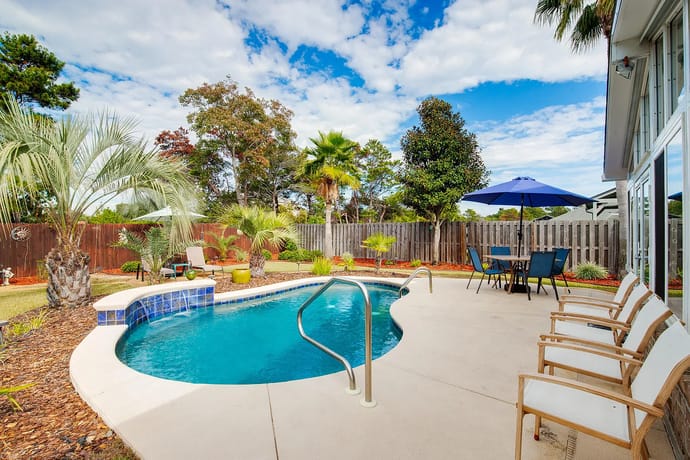
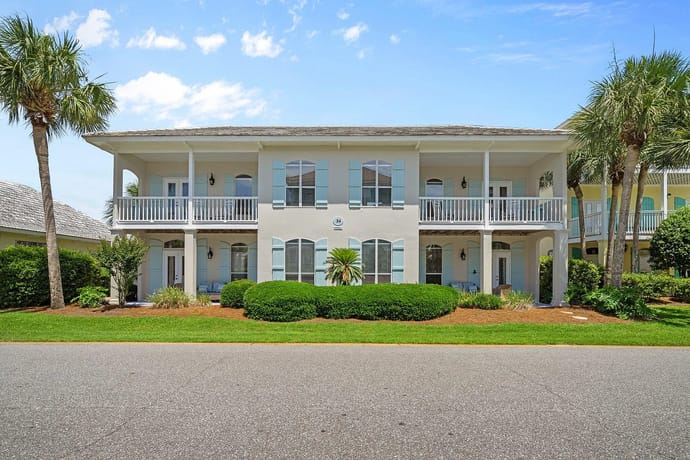
Both of our properties are set up for longer stays — full kitchens, washer/dryer, fast WiFi, and real living space rather than just vacation beds. Our Miramar Beach rental has 4 bedrooms, a private pool, and sleeps 8 from $225/night — ideal for couples who want to invite family during a scouting trip, or for trying a neighborhood where you might eventually buy. Our Destin rental is 3 bedrooms plus a bunk room, sleeps 12, and is pet-friendly from $110/night — great for extended stays with a larger group or multiple generations.
Monthly rates can be lower than the nightly rate implies — contact the properties directly for extended stay discussions on 28+ day bookings.