Almost everyone who visits Destin for the first time thinks the same thing on day two: I could buy a place here. The beach earns that thought — sugar-white sand, Gulf water that's genuinely emerald green, and a demand pipeline of families, couples, and groups that refills every spring and summer like clockwork. But going from "I could buy a place here" to actually making money on one is where enthusiasm collides with reality.
This guide covers the Destin vacation rental market honestly — not as a sales pitch, but as a practical framework for evaluating whether this investment actually makes sense for your situation. We own properties on both sides of the Destin/Miramar Beach line and have learned a few things the hard way.

Why Destin Is a Strong Vacation Rental Market
The fundamentals of the Destin market are genuinely solid. The Emerald Coast consistently ranks among the top beach destinations in the country — not because of marketing, but because the beach actually looks like the photos. That's a floor under demand that doesn't exist at most coastal markets.
- Deep demand from a huge feeder market. Atlanta (4.5 hours), Birmingham (3 hours), Nashville (6 hours), New Orleans (4.5 hours), and Dallas (10 hours) together represent roughly 15 million people within a comfortable drive. Drive-to beach destinations have a significant structural advantage — no flights to coordinate, no baggage limits, no airline delays. Destin sits at the sweet spot of reachable but still feels like a real getaway.
- Year-round bookability. Destin isn't just a summer market anymore. February and March bring snowbirds who book for weeks at a time. Spring break generates peak-level demand in March and April. Fall shoulder season (September–November) has grown substantially — the Gulf stays warm through October, crowds drop, and rates hold strong. The window of meaningful occupancy now spans roughly 8–9 months.
- Strong repeat visitor rate. Families who find a property they love tend to rebook the same property the following year. The first booking is the hardest; if the property delivers, the second comes automatically. This reduces platform dependency and stabilizes occupancy from year to year.
- High rate tolerance. Gulf-front and Gulf-view properties command nightly rates that are high by regional standards — $400–900/night for a 3–4BR Gulf-front home in July is realistic. Even in-neighborhood properties with private pools pull $200–450/night in peak season. The ceiling is legitimately high compared to most inland or secondary coastal markets.
- Florida's STR-friendly regulatory environment. Florida state law preempts municipalities from banning short-term rentals outright — a major structural advantage over markets like Nashville or Austin where STR regulations have dramatically restricted supply and created ownership risk.

What Property Types Perform Best
Not all vacation rental properties in the Destin area perform equally. Several factors separate the consistently high performers from the properties that disappoint investors:
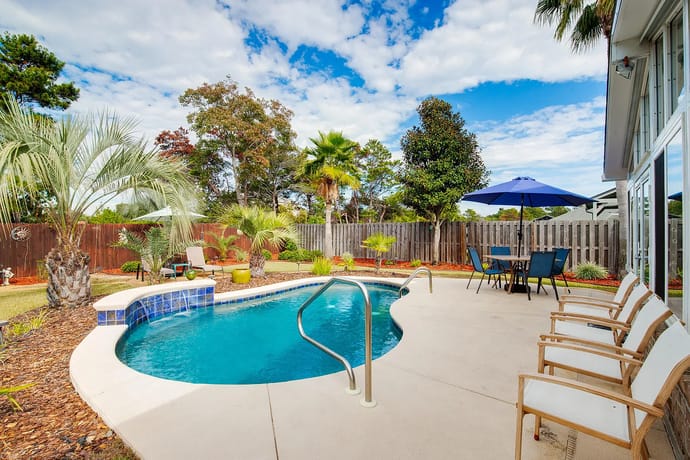
- Private pool is close to mandatory. Gulf-front and Gulf-view properties sell themselves on location. For in-neighborhood properties — which make up most of the affordable inventory — a private pool is the single biggest driver of occupancy and rate. Guests filter for private pools on VRBO and Airbnb. Properties without one compete mostly on price, compressing margins. A private pool typically adds $40–70/night to viable nightly rate and fills shoulder-season bookings significantly faster.
- Sleeps 8+ outperforms smaller. The vacation rental math strongly favors properties that can accommodate a full family group or two-couple group. A property sleeping 10 gets booked by groups splitting cost four ways — price sensitivity drops dramatically when divided among 8+ adults. Moving from 6 beds to 8 beds often improves both rate and occupancy.
- Single-family home vs. condo. Single-family homes with private pools outperform similarly priced condos in most segments. Condos carry HOA fees ($400–900/month is typical) that eat margins, and HOA rental restrictions are increasingly common. Condos at well-managed beachfront complexes are the exception — those can perform extremely well on nightly rate due to Gulf proximity. But for in-neighborhood properties, a house beats a condo.
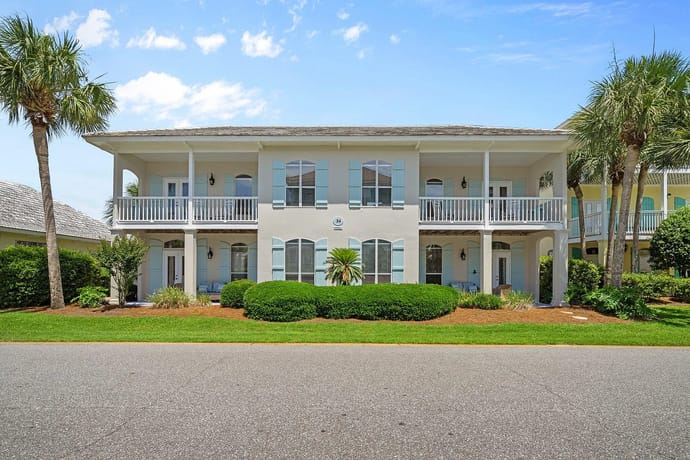
- South-of-98 location matters. Properties between US-98 and the Gulf command meaningfully higher rates and occupancy than comparable properties north of the highway, even without a Gulf view. Walkability to the beach is worth real money to guests. Our Miramar Beach property sits south of 98 with a private pool — that combination consistently outperforms comparable-bedroom properties further from the water.
- New build or freshly renovated wins on platforms. VRBO and Airbnb give algorithm boosts to new listings, and a beautifully staged, Instagram-worthy property accumulates 5-star reviews quickly. The rate gap between a well-decorated 2023-build and a dated 2010 property can easily be $75–100/night on comparable bedrooms and square footage.

Realistic Income & Operating Costs
This is where potential investors most often get misled — sellers and agents quote gross revenue. Before evaluating any property, you need a clear picture of the full expense stack:
- Gross rental income. A well-positioned 4BR/4BA private pool home in Miramar Beach might generate $85,000–110,000 in gross annual revenue in a solid year. A comparable Gulf-front property can push $130,000–170,000. A 3BR condo at a Gulf-front complex might generate $65,000–90,000. These are rough ranges — a local property manager can pull actual comparable rental data for any specific street or complex.
- Property management (22–35% of gross). Full-service management (Vacasa, local boutique managers) typically charges 22–35% of gross revenue. For out-of-state investors, this is essentially non-negotiable. On $95,000 gross, that's $21,000–33,000 off the top before any other expense.
- Coastal insurance (the number that surprises people most). Wind and flood insurance on the Gulf Coast is expensive. A $750,000 property can easily cost $10,000–15,000/year for adequate wind/flood/liability coverage. Some lenders require specific minimums. Get an insurance quote before you make an offer — this cost is not negotiable once you own it.
- Property taxes. Okaloosa County (Destin) and Walton County (Miramar Beach) property taxes on a $750,000 non-homesteaded investment property run roughly $7,000–10,000/year. No homestead exemption discount applies to investment properties.
- Maintenance & supplies (8–12% of gross). Vacation rental properties take hard wear. Budget for HVAC issues, appliance failures, pool service, lawn care, periodic furniture replacement, and consumable supplies. This is not optional — a badly maintained property loses reviews fast.
- HOA fees (condos). Condo HOAs in the area run $400–900/month — up to $10,800/year in fixed costs regardless of occupancy. Factor this into any condo analysis before comparing to single-family alternatives.
- Tourist development tax. Florida charges 6% state sales tax plus a 5% county tourist development tax on short-term rental revenue. This is passed to guests as a booking fee, but remittance is the owner's responsibility. Property managers handle it automatically; self-managing owners must file monthly or quarterly with the county tax collector.
Back-of-napkin reality check: On a $750,000 property generating $95,000 gross, subtract: $28,500 management (30%) + $12,000 insurance + $8,500 taxes + $10,000 maintenance + $2,500 misc = approximately $33,500 net before debt service. At today's rates, a $600,000 mortgage runs roughly $42,000/year in debt service. That means break-even in a good year, with appreciation and personal use carrying the investment thesis. Understand this going in.

Which Neighborhoods to Look In
The Destin-to-30A corridor stretches roughly 25 miles, and location within it matters significantly for rental performance and acquisition price. Here are the neighborhoods worth focusing on:
- Crystal Beach / Destin proper (Okaloosa County). The residential neighborhood east of Destin Harbor, south of US-98. Single-family homes, walkable proximity to HarborWalk Village and the East Jetty, and a genuine neighborhood feel. Entry prices for 3–4BR homes start around $650,000–850,000. Strong rental demand driven by activity proximity — guests can walk to Crab Island pontoon rentals, dolphin cruises, and harbor dining. Our Destin property is in this corridor.
- Miramar Beach south of US-98 (Walton County). A quieter residential feel between Destin and Sandestin — single-family homes with pools, close to the Gulf, and Walton County's historically STR-friendly environment. Entry prices for 3–4BR private pool homes start around $600,000–800,000. Our Miramar Beach property is here: 4BR, private pool, south of 98, strong year-round occupancy.
- Sandestin Golf & Beach Resort. Gated community with resort amenities, golf, and beach club access. HOA-managed STRs typically require use of the resort's own rental program — this limits income flexibility but provides true passive management. HOA fees run $500–800/month. Good for investors who genuinely want hands-off ownership rather than maximizing yield.
- Holiday Isle / Scenic Gulf Drive (Gulf front, Destin). Condos and homes directly on the Gulf. Price per square foot is highest here ($500–700+/sqft for Gulf front), but so are gross rental rates — $120,000–180,000 annually for a 4BR Gulf-front property isn't unusual. The trade-off: acquisition cost and flood/wind insurance exposure are both at maximum here.
- Emerald Grande at HarborWalk (Destin Harbor). Luxury high-rise condos on the harbor with a view of the East Pass rather than the Gulf beach. Strong appeal to corporate travelers, fishing-trip groups, and guests who want walkability to the harbor scene. Entry starts around $600,000 for a 1BR. A genuinely unique product in the market with its own demand niche.

Regulations, Taxes & What to Watch For
Florida's regulatory environment for short-term rentals is meaningfully more investor-friendly than most comparable coastal markets. But "friendly" doesn't mean "no rules." Know what you're walking into before you close:
- State preemption of STR bans. Florida law preempts municipalities from banning short-term rentals outright. Destin and Miramar Beach cannot replicate what cities like Nashville and Austin have done to their STR markets. This is a genuine structural advantage and one of the primary reasons the Gulf Coast remains a viable investment destination when comparable beach markets have become regulatory minefields.
- Florida DBPR license required. All vacation rentals in Florida must register with the Department of Business and Professional Regulation as a "vacation rental" and pass an inspection. Annual license fees run $385–675 depending on the property type. Operating without a license carries real fines.
- County tourist development tax registration. Okaloosa County and Walton County each require separate registration for tourist development tax collection and remittance. The combined state + county short-term rental tax burden is 11% of gross revenue (6% state + 5% county). Property managers handle this; self-managing owners must file on a monthly or quarterly schedule.
- HOA and deed restrictions — the non-regulatory minefield. This is where most investors get caught off guard. Some HOAs impose minimum rental periods (7-night minimums are common), annual caps on rental days, or outright bans on platforms like Airbnb. These restrictions can materially reduce rental income and aren't always disclosed in the listing. Get the full HOA documents and have an attorney review them before closing.
- Flood zone status determines insurance cost. Many properties south of US-98 are in FEMA Flood Zone AE, requiring mandatory flood insurance. Pull the flood zone map for any property you're seriously considering. The insurance cost difference between Zone X and Zone AE can be $4,000–8,000/year — material for the underwriting.
- Noise, parking & neighbor complaints. Some residential streets in Destin proper have STR-specific noise ordinances or parking rules following complaints from full-time residents. These vary by neighborhood and aren't always obvious from a listing. Ask a local property manager about the specific street before you buy.
Experience the Product Before You Buy
The best research for a Destin vacation rental investment isn't a spreadsheet — it's staying in a well-run property and understanding firsthand what guests expect and what makes them rebook. Before you make an offer, spend a long weekend in a property that matches your target investment profile. You'll learn more about what makes guests happy (or frustrated) from one stay than from hours of online research.
Our Miramar Beach property (4BR, private pool, sleeps 8, from $225/night) is the kind of south-of-98 private pool home that performs consistently in this market. Our Destin property (3BR + bunk room, pet-friendly, sleeps 12, from $110/night) shows what a higher-capacity home looks like from the guest's perspective.